- (417) 674-4531
- info@treeservicejoplinmo.com
- Mon - Fri: 9:00 - 18:30
SELECTIVE REMOVAL OF DEAD BRANCHES
Deadwood Removal in Joplin, MO
A tree can be healthy overall and still carry dead branches in its canopy. Deadwood removal is the selective removal of dead, broken or damaged branches from a standing tree, leaving the living tree in place.
If you’ve noticed dead limbs in a tree on your Joplin property, especially over a driveway, roof or walkway, call to describe what you’re seeing and talk through whether deadwood removal makes sense.

What Is Deadwood Removal?
Deadwood removal, sometimes called deadwood pruning, focuses on branches that are no longer alive. The work targets dead limbs and dead portions of the tree canopy, along with broken or damaged branches, while the healthy structure of the tree stays intact.
It is a specific, targeted part of tree care. Utah State University Extension’s overview of pruning landscape trees lists the removal of broken or dead branches as part of pruning for tree health, and the removal of dead and decaying branches as a way to reduce hazards.
Why Remove Dead Branches From a Tree?
Dead branches don’t grow or strengthen over time. As they dry out and decay, they can become brittle and may break and fall, sometimes without obvious warning.
Branches die for many different reasons. Lower or inner branches may be shaded out as the canopy grows, and others may have been damaged by storms, previous pruning or mechanical injury. A single dead branch does not mean the whole tree is dying or diseased.
Removing dead branches can reduce the chance of dead wood falling onto people or property, and it can make the tree’s living canopy easier to evaluate.
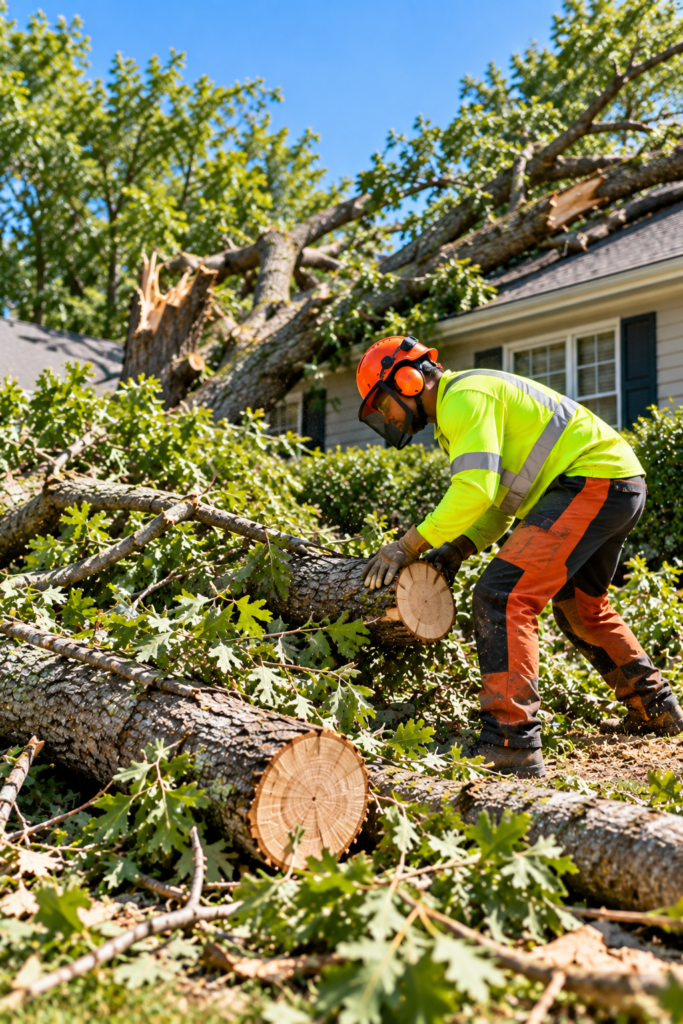

Dead and Broken Branches Around Property
Location matters. A dead limb high over an unused corner of a yard is a very different situation from one hanging above a driveway, walkway, roof, patio or play area. Dead branches over frequently used areas are often the first to be considered for removal.
Broken or hanging branches deserve extra caution. They can be under tension, partly attached or caught in other branches, and they can shift or drop unexpectedly. Keep people and pets out from underneath them, and don’t try to pull them down or cut them yourself.
Removing deadwood can reduce some risk, but it cannot make a tree completely safe or prevent all future branch failures.
Deadwood Removal vs. Dead Tree Removal
These are two very different services. A living tree can contain dead branches, and removing that deadwood does not mean the tree has to come down. In many cases, the tree stays and only the dead branches are removed.
Dead tree removal is for a tree that is dead or substantially dead as a whole. If much of a tree’s canopy appears dead, or there are broader structural or health concerns, a more complete assessment may be appropriate before deciding what to do.

When Deadwood May Need Further Assessment
A few dead branches are common in many trees. Some patterns, however, may warrant a closer look, such as:
- Dieback spreading through large parts of the canopy
- Dead branches concentrated on one side of the tree
- New dead branches appearing with no clear cause
- Deadwood alongside cracks, fungal growth, leaning or other changes
These signs may indicate a broader issue, but they can’t confirm one on their own. A tree inspection or tree health assessment can help look at the tree’s overall condition before any decisions are made.
Deadwood Removal vs. General Tree Pruning
Deadwood removal is one narrow part of tree pruning. General pruning can involve selective cuts to living branches for structure, clearance, form or health. Deadwood removal focuses on branches that are already dead, broken or damaged.
Because it mainly removes wood the tree is no longer using, deadwood work usually has less effect on the living canopy than pruning live branches. It is still skilled work, since dead wood can behave unpredictably when it is cut or lowered.
Deadwood Removal and Tree Care
Maintaining the canopy
Checking for and removing deadwood is a practical part of routine tree maintenance. Addressing dead branches as they appear helps keep the canopy in better condition and makes changes in the tree easier to notice over time.
Why the whole tree isn’t removed automatically
Individual dead branches are not, by themselves, a reason to remove a tree. Removing a tree is a much bigger decision that depends on its overall condition, structure and surroundings, not on one visible symptom.
Safety and power lines
If a dead or broken branch is near or touching an electrical line, stay clear. Don’t touch the branch or the line, and don’t try to remove it. Contact the utility. If a line is down, stay away from it and anything it touches, and call 911 and Liberty Utilities at 1-800-206-2300.
Related Tree Services
Deadwood removal often fits alongside other work, such as removing a specific branch that is damaged or in the way. Where a tree has serious structural concerns rather than just a few dead limbs, hazardous tree removal may be worth discussing. For everything else, you can explore our full range of tree services in Joplin.
Deadwood Removal FAQs
Deadwood removal is the selective removal of dead, broken or damaged branches from a standing tree, while the living tree and its healthy canopy stay in place.
No. Living trees often have some dead branches, which can result from shading, past damage or other causes. Widespread dieback may warrant a closer look, but one dead branch doesn’t mean the tree is dying.
Not always. Dead branches over homes, driveways, walkways or other frequently used areas are often the priority. Whether others should be removed depends on their size, location and the tree.
It is one specific type of tree pruning. General pruning can include cuts to living branches, while deadwood removal focuses on branches that are already dead, broken or damaged.
Deadwood removal takes dead branches out of a standing tree. Dead tree removal removes an entire tree that is dead or substantially dead.
They can. Dead wood can become brittle and may break without obvious signs, which is why it’s wise to keep people away from dead or hanging branches.
Extensive deadwood may indicate a broader problem with the tree, but it can’t be diagnosed from appearance alone. A closer assessment of the tree’s overall condition may be appropriate.
Dead Branches in Your Tree?
Call to describe the tree and where the dead branches are, and talk through whether deadwood removal is a suitable option.
Get Quick Estimate
Copyright 2024 | All RIghts Reserved