- (417) 674-4531
- info@treeservicejoplinmo.com
- Mon - Fri: 9:00 - 18:30
BALANCED, NATURAL-LOOKING TREE FORM
Tree Shaping in Joplin, MO
A tree that has grown lopsided, crowded one side of the house, or lost its balance after a storm can often be improved with careful, selective work. Tree shaping focuses on a tree’s form and balance, working with its natural growth habit rather than forcing it into an artificial outline.
If a tree on your Joplin property looks uneven or overgrown, call to describe what you’d like to change and talk through whether shaping makes sense for that tree.

What Is Tree Shaping?
Tree shaping is the selective management of a tree’s canopy to improve its overall form, balance and appearance, while keeping its structure and health in mind. It usually involves removing or shortening specific branches so the canopy looks more even and grows in a better direction.
The USDA Forest Service’s guide on how to prune trees describes pruning for appearance as enhancing a tree’s natural form and character, and notes that imposing an unnatural form on a tree requires constant maintenance. Good shaping follows that idea: it refines the shape a tree already wants to grow into.
When Can Tree Shaping Be Useful?
- A canopy that has grown lopsided toward light or away from nearby trees
- One side of the tree crowding a roof, wall or neighboring tree
- A young tree developing its form and branch spacing
- A tree left unbalanced after storm damage or the loss of a large limb
- Overgrown branches that make a tree look untidy in a visible spot
Shaping is often combined with other goals, such as keeping clearance over a walkway or removing dead branches at the same time.

Managing Canopy Balance and Branch Growth
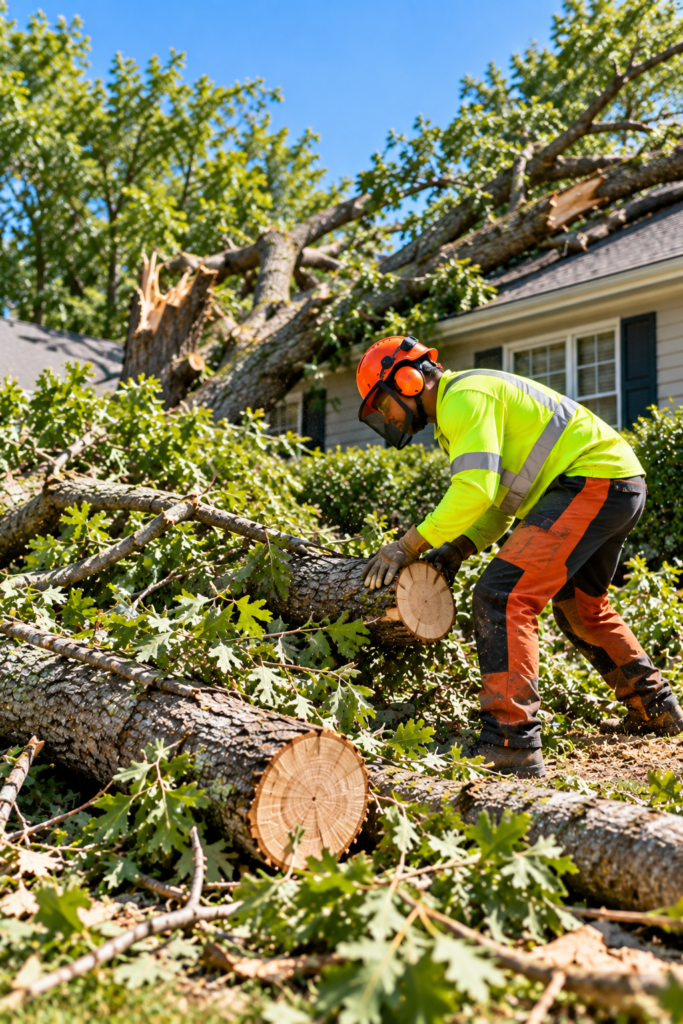
Shaping works through selective cuts rather than shearing the outside of the canopy. That generally means favoring well-attached branches, removing ones that cross, rub or compete, and shortening overgrown limbs back to a suitable side branch.
How much comes off matters. Keeping enough live canopy helps the tree stay healthy, and stripping out the inner branches so foliage only remains at the tips, sometimes called “lion’s tailing,” weakens branches and should be avoided. Larger changes in shape are often spread over time rather than done all at once.
Shaping Young Trees vs. Mature Trees
Young trees are the easiest to shape. Guiding their form early, while branches are small, can set up a balanced canopy and strong structure with relatively minor cuts.
Mature trees can often be shaped too, but the work is usually lighter and more corrective: evening out a lopsided side, reducing a few overextended limbs, or restoring balance after damage. Established trees don’t respond well to heavy cutting, so the goal is refinement rather than a dramatic change.

When Tree Shaping May Not Be Appropriate
- A tree that has outgrown its space. Shaping can’t permanently hold a tree at a smaller size, and repeated heavy cutting to try usually does more harm than good.
- Structural or health concerns. Cracks, decay, dieback or a changing lean deserve a tree inspection before any cosmetic work.
- Branches near power lines. Work near lines is for the utility or qualified line-clearance workers, not a shaping job.
- A desired look that would remove too much live growth. Some trees simply can’t be made symmetrical without harming them.
Tree Shaping vs. Tree Trimming vs. Tree Pruning
These services overlap, and one visit often includes a little of each. Tree trimming focuses on practical results like clearance over roofs and driveways and keeping trees tidy. Tree pruning covers selective branch removal for specific objectives, especially structure and health.
Tree shaping sits between them. Its main goal is the tree’s overall form and balance, but it still relies on the same careful, selective cuts that protect the tree’s structure and long-term health.
Shaping Without Harming the Tree
Work with the tree’s natural form
Every tree has a natural growth habit, whether broad and rounded or upright with a central stem. Shaping that respects that habit tends to look better, last longer between visits and cause less stress than trying to force a different outline.
Avoid topping and heavy cuts
Topping, which cuts large branches back to stubs to reduce height, and similar heavy cutting harm trees. They lead to weak, fast-growing sprouts, decay and a worse shape over time. Cuts made flush against the trunk or that leave long stubs also slow wound closure.
Safety and power lines
Shaping involves cutting branches overhead and often working off the ground, so it isn’t a job for DIY chainsaw work, ladders or climbing. Never prune branches near power lines; contact the utility instead. If a tree or branch is on a downed line, stay clear and call 911 and Liberty Utilities at 1-800-206-2300.
Related Tree Services
Shaping works best as part of broader tree maintenance, where branch work, health checks and after-storm care are planned around each tree. See the full range of our tree services in Joplin.
Tree Shaping FAQs
It’s the selective management of a tree’s canopy to improve its form, balance and appearance, working with the tree’s natural growth habit and keeping its structure and health in mind.
Trimming focuses mainly on practical goals like clearance and tidiness. Shaping focuses on the tree’s overall form and balance. The two often happen together.
Shaping uses pruning cuts, but pruning is broader and covers other objectives like structure, health and safety. Shaping is pruning with the tree’s form and appearance as the main goal.
Often, yes. Selective cuts can help even out a lopsided canopy over time, though how much can change depends on the tree’s structure and how much live growth can safely be removed.
Careful, selective shaping shouldn’t harm a healthy tree. Harm usually comes from heavy cutting, topping, stripping inner branches or removing too much live canopy at once.
It depends on the tree’s age, growth rate, condition and your goals. Some trees benefit from occasional light shaping, while others rarely need it.
Often, but usually with lighter, corrective work rather than big changes. Mature trees don’t respond well to heavy cuts, so shaping them focuses on refinement.
Want a More Balanced Look for Your Tree?
Call to describe the tree and the look you’d like, and talk through whether shaping is a good fit.
Get Quick Estimate
Copyright 2024 | All RIghts Reserved