- (417) 674-4531
- info@treeservicejoplinmo.com
- Mon - Fri: 9:00 - 18:30
ASSESSING AND CARING FOR STORM-DAMAGED TREES
Storm Damage Tree Service in Joplin, MO
After a storm, it can be hard to tell whether a damaged tree needs a few broken branches removed, careful monitoring, or complete removal. Storm damage tree service focuses on that question: inspecting storm-damaged trees, dealing with the hazards they create, and deciding what work actually makes sense.
If trees on your Joplin property were damaged in a recent storm, keep clear of broken limbs and call to describe what you’re seeing. If a tree is touching power lines, call 911 and the utility first.

What Storm Damage Can Do to Trees
Wind, heavy rain, ice and hail affect trees in different ways. Common types of storm-related tree damage include:
- Broken branches, from small twigs to major limbs
- Hanging branches that snapped but stayed caught in the canopy
- Canopy damage, where one side of the tree is stripped or lopsided
- Split or cracked trunks, often where two main stems meet
- Leaning or shifted trees, sometimes with soil lifted at the base
- Root damage that isn’t always visible above ground
- Fallen trees, fully or partially uprooted
The same storm can leave one tree needing nothing more than cleanup and another that is no longer stable.
Signs of Storm Damage That Need Attention
Some changes may warrant a professional tree inspection, even if the tree still looks mostly intact:
- New cracks in the trunk or at a major branch union
- Bark torn away where a large limb broke off
- Soil heaving or cracking on one side of the tree
- A lean that wasn’t there before, or one that seems to be increasing
- Broken limbs hanging over a roof, driveway, walkway or play area
- Branches resting on or near power lines
None of these signs alone decides a tree’s future. They’re reasons to keep clear and have the tree looked at as a whole.

Broken and Hanging Branches
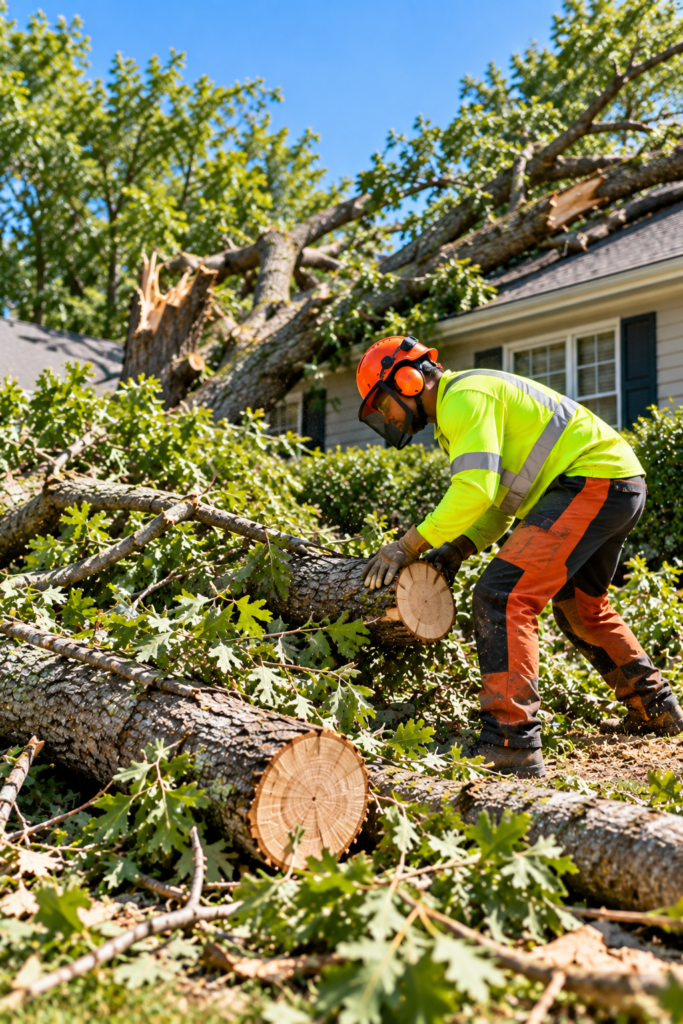
Broken and hanging branches are the most common storm damage and often the most hazardous in the short term. A limb caught in the canopy can drop without warning, sometimes days after the storm, even in calm weather.
Once it’s safe to work, damaged limbs are typically removed and torn branches cut back to sound wood so the tree can close the wounds cleanly. Large or tangled limbs, and anything bent under strain, should be handled by experienced crews, not from a ladder or from the ground beneath them.
Leaning, Split and Partially Fallen Trees
When the trunk or roots are involved, the question shifts from individual branches to the stability of the whole tree. A split trunk, a tree that has tipped and lifted its root plate, or one that is partly fallen and resting against a structure or another tree may no longer be safe to keep.
If a tree like this threatens a home, road or access, emergency tree removal may be needed. If there’s no immediate threat, the tree can be assessed and a decision made without rushing.

Storm Cleanup Considerations
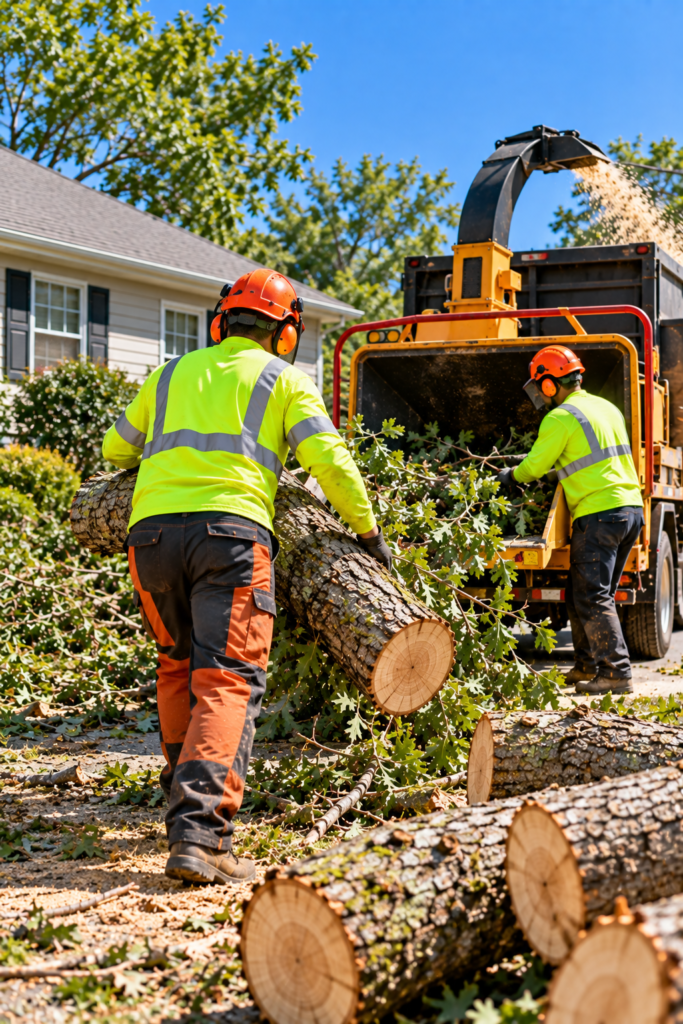
Storm cleanup often involves more than one tree. Factors that affect the work include:
- How many trees are damaged and how badly
- Branches or trees resting on structures, fences or vehicles
- Power lines touching or near damaged trees
- Debris blocking driveways, gates or equipment access
- Whether wood and branches are chipped, hauled away or left on site
After larger storms, the City of Joplin has offered curbside pickup of limbs, but it has also said its crews do not enter private property to cut up or remove trees. Check the City’s current guidance before stacking debris at the curb.
Can a Storm-Damaged Tree Be Saved?
Often, yes. University of Missouri Extension’s guidance on first aid for storm-damaged trees sorts damaged trees into three groups: keep it, wait and see, or replace it. A useful rule of thumb from that guidance is whether at least half of the tree’s crown is still intact, and it advises resisting the urge to cut a borderline tree down right away.
When damage is limited to branches and the trunk and roots are sound, careful pruning can help the tree recover and rebuild its structure over the next few seasons. Topping isn’t the answer, because it weakens trees further. When the trunk is split, most of the crown is gone, or the roots have failed, tree removal may be the better long-term choice.
Staying Safe Around Storm-Damaged Trees
Keep clear
Keep people, pets and vehicles away from damaged trees, hanging limbs and anything a tree is resting on. Don’t cut, pull, climb or prop up a storm-damaged tree, and avoid walking under broken branches while checking your property.
Power lines
Treat any line touching a tree as energized. Don’t touch the tree, the branch or the line. Liberty Utilities, which provides electric service in the Joplin area, directs customers to call 911 and Liberty at 1-800-206-2300 about downed lines. Tree work near the lines can only begin once the utility has made the area safe.
When it can’t wait
A tree on a house, a trunk blocking your only access, or a tree shifting toward a structure needs prompt attention. In those situations, emergency tree service is the right starting point. Everything else can usually be inspected and planned once the storm has passed.
Related Tree Services
Storm damage often leads to other work: grinding stumps from trees that had to come down, trimming branches that now overhang the roof, or checking trees that weren’t obviously hurt. See the full range of our tree services in Joplin.
Storm Damage Tree Service FAQs
Keep clear of broken limbs and anything the tree is resting on, check from a distance for power lines, and take photos. If there’s no immediate hazard, have the tree inspected before deciding on pruning or removal.
Often. Trees with limited branch damage and sound trunks and roots usually recover with proper pruning. University of Missouri Extension suggests, as a rule of thumb, that at least half of the crown should remain intact.
Warning signs include new trunk cracks, a split at a major union, lifted soil at the base, a new or increasing lean, and large hanging limbs. These are reasons for an inspection, not a diagnosis on their own.
No. Many storm-damaged trees only need broken branches removed. Removal is generally considered when the trunk is split, most of the crown is lost, or the roots have failed.
Stay out from under them and keep others away, even after the wind has stopped. Don’t try to pull them down. Call to have them removed safely.
Stay away and don’t touch the tree or the line. Call 911 and Liberty Utilities at 1-800-206-2300, and wait for the utility to make the area safe before any tree work.
When a tree or large limb is on a structure or vehicle, blocking access, shifting toward something, or involved with power lines. Other storm damage can usually be inspected and scheduled.
Trees Damaged in the Last Storm?
Call to describe the damage and arrange a storm damage tree service estimate.
Get Quick Estimate
Copyright 2024 | All RIghts Reserved